
Basic Data Types:
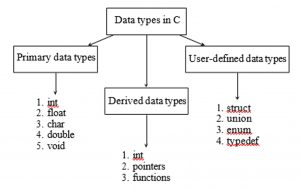
int: Used to store integer values.
int age = 25;
float: Used to store single-precision floating-point numbers.
float salary = 50000.75;
double: Used to store double-precision floating-point numbers.
double pi = 3.141592653589793;
char: Used to store single characters.
char grade = ’A’;
void: Represents the absence of a type. It is often used as a return type for functions that do not return a value.
| void printMessage() { printf(“Hello, World!\n”); } |
Derived Data Types:
Arrays: A collection of elements of the same type.
int numbers[5] = {1, 2, 3, 4, 5};
Pointers: Variables that store memory addresses.
int *ptr = &age;
Functions: Blocks of code that perform specific tasks.
| int add(int a, int b) { return a + b; } |
User-Defined Data Types:
Structures: A collection of variables of different types under a sin- gle name.
| struct Person { |
||
| char name[50]; | ||
| int age; | ||
| float salary; | ||
| }; | ||
Unions: Similar to structures, but all members share the same memory location.
| union Data { |
||
| int i; | ||
| float f; | ||
| char str[20]; | ||
| }; | ||
Enumerations: A user-defined type consisting of a set of named integer constants.
enum Days {Sun, Mon, Tue, Wed, Thu, Fri, Sat};
| Data Type |
Size (in Bytes) |
Format Specifier |
Typical Range (32-bit System) |
| char | 1 | %c | -128 to 127 (Signed) / 0 to 255 (Unsigned) |
| int | 4 | %d | -2,147,483,648 to 2,147,483,647 |
| float | 4 | %f | ∼3.4E-38 to ∼3.4E+38 (6 decimal places) |
| double | 8 | %lf | ∼1.7E-308 to ∼1.7E+308 (15 decimal places) |
Note: Sizes may vary depending on system architecture (e.g., 32-bit vs. 64-bit).
Type Casting and Type Conversion
1. Type Casting
Type casting is the process of explicitly converting a variable from one data type to another by the programmer.
Syntax:
(type) expression;
Example:
#include <stdio.h>
int main()
{
int a = 5, b = 2;
float result;
result = (float)a / b; // type casting
printf(“Result = %f”, result);
return 0;
}
Here, a is converted to float before division.
2. Inbuilt Type Casting Functions in C
Some commonly used library functions for type conversion are:
- atoi() – converts string to integer
- atof() – converts string to float
- atol() – converts string to long integer
- itoa() – converts integer to string
3. Difference Between Type Casting and Type Conversion
| Type Casting | Type Conversion |
| Done explicitly by the programmer | Done automatically by the compiler |
| Also called explicit conversion | Also called implicit conversion |
| The programmer specifies the new data type | The compiler decides the data type conversion |
| Example: (float)a | Example: int + float → float |
Example of Type Conversion (Implicit):
int a = 5;
float b = 2.5;
float c;